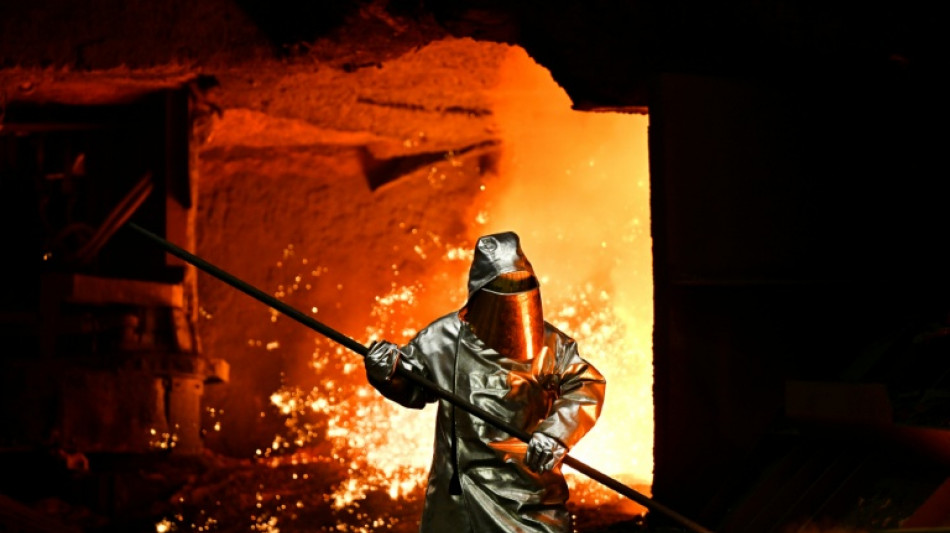
EU leaders push to rescue European economy challenged by China, US / Photo: Ina FASSBENDER - AFP
EU leaders will converge on a Belgian castle on Thursday as the bloc seeks ways to punch its economic weight on the global stage -- faced with threats from China and the United States, and hamstrung by its own divisions.
It is a challenge that has long dogged the European Union, but has gained greater urgency because of geopolitical turbulence, intensified global competition and an economy that lags behind bigger powers.
The leaders of the bloc's 27 countries will try to bridge their differences on how to transform the European economy at the 16th century Alden Biesen castle, guided by a landmark report published 18 months ago.
"The urgency could not be greater. We are fighting for a place in the new global economy," EU chief Ursula von der Leyen told industry chiefs Wednesday.
French President Emmanuel Macron doubled down, warning the bloc needed to act at "a new scale and new speed" to stop the "fragmentation, weakening and probably the humiliation of Europe."
Macron also renewed a call for joint EU debt -- a divisive idea among European capitals -- as the "only way" to compete with China and the United States.
The European Commission president will be promoting a host of solutions at Thursday's talks -- including a French-backed "Buy European" push, "simplifying" EU rules and striking more deals to diversify trading partners.
The "European preference" proposal will likely be the source of fierce debate during the meeting as several countries including Sweden and the Netherlands -- proponents of free trade -- caution against veering into protectionism.
German Chancellor Friedrich Merz said it should be a "last resort".
The commission also believes creating a new legal system for businesses outside of the scope of member states -- the so-called 28th regime -- would make it easier for companies to work across the 27 countries.
- Deepening the single market -
But von der Leyen and many in the EU believe the real answer is deeper integration of the single market, as argued in the milestone report by former European Central Bank chief Mario Draghi.
"A 28th regime is a neat idea, but true single market integration is needed, and there are no shortcuts in getting there," said Varg Folkman, a policy analyst at the European Policy Centre (EPC) think tank.
Draghi's report will not be the only report leaders will be leaning on.
After Draghi speaks to the leaders in the morning, they will then hear from Italian ex-premier Enrico Letta, who has called for deeper integration, including a savings and investments union to help companies access capital.
Unlike their American rivals, European companies face challenges accessing capital to scale up despite the fact that Europe is home to some of the world's biggest economies including Germany and France.
- Directing EU money to Europeans -
Billed as a "strategic brainstorming," Thursday's talks were not expected to produce immediate action.
Diplomats said the meeting will be dominated by two issues: energy prices and the "Buy European" drive.
Von der Leyen backed the call for public buyers to favour European firms, and said the EU executive would propose a law on European preference this month.
"We will introduce specific EU content requirements for strategic sectors," she said. "Let us direct more European money to our European industries."
EPC's Folkman warned the EU against "unmitigated protectionism".
"The bloc must push back against the US and China, but it must not do so at the cost of alienating global partners," he said.
J.Klein--VZ