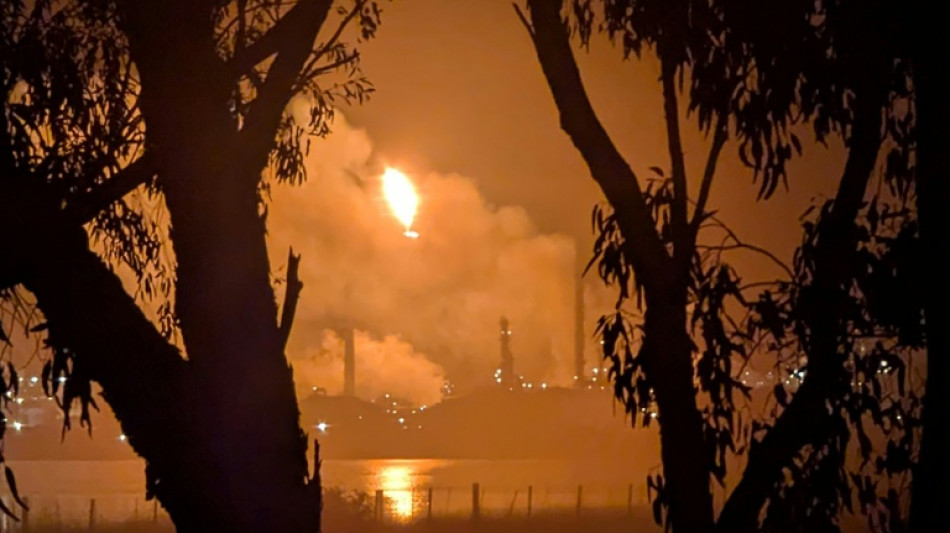
Fuel supply fears after blaze tears through crucial Australian refinery / Photo: Handout - Giuliana Elakis/AFP
Towering columns of fire have engulfed a crucial Australian oil refinery after a chain of explosions, authorities said Thursday as they warned of disruptions to domestic fuel supply.
Flames as tall as 60 metres (200 feet) erupted late Wednesday night after a gas leak caught fire at the Viva fuel plant in Victoria state, firefighters said, one of only two working oil refineries in Australia.
"The major impact at this point appears to be on petrol production," Energy Minister Chris Bowen said.
"It's not great. It's not great timing, is it?" he told national broadcaster ABC.
The refinery, about an hour's drive southwest of state capital Melbourne, pumps out about 10 percent of Australia's fuel, according to energy company Viva.
It is capable of producing up to 120,000 barrels of oil each day, company figures stated.
The fire ripped through a section of the refinery responsible for the production of high-octane petrol, Bowen said.
By triggering isolation valves, other parts of the plant producing jet fuel and diesel had been spared the worst of the blaze.
Images taken Thursday morning showed thick clouds of smoke billowing over the industrial complex.
Geographically isolated and with only two oil refineries, Australia is heavily exposed to disruptions in global fuel supply and imports most of its petrol.
Bowen urged Australians to ignore the impulse to rush out and panic buy more fuel.
"It's important that people buy as much fuel as they need. But no more, no less."
- 'Ferocious' -
Incident controller Mark McGuinness said a "significant leak" of highly flammable gases and liquid hydrocarbons had triggered the inferno.
"The fire has continued to burn overnight and is still burning at the moment," he told reporters.
"It was quite ferocious. It went from a small fire through several explosions to a large, intense fire."
It would burn for at least another "four to five hours" he said.
Australia holds roughly 38 days' worth of petrol in reserve, according to government figures, far below the 90-day minimum dictated by the International Energy Agency.
While the government has so far resisted moves to ration fuel, it has urged drivers to conserve petrol where they can and to favour public transport if possible.
Like most nations in Asia and the South Pacific, Australia is heavily reliant on oil shipped through the Strait of Hormuz, which at one point carried one-fifth of the world's oil and gas.
Shipping traffic through the vital waterway has essentially ceased since the United States and Israel launched strikes against Iran on February 28.
F.G.Fischer--VZ