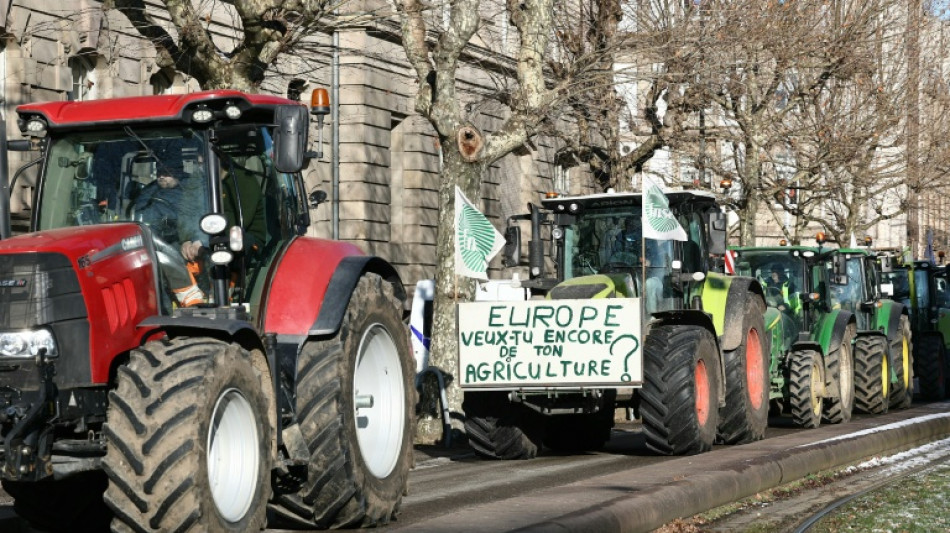
Thousands of farmers protest EU, Mercosur trade deal ahead of vote / Photo: Frederick FLORIN - AFP/File
Thousands of farmers driving tractors and waving flags descended Tuesday on the European parliament in Strasbourg in protest at a major trade deal signed with South America, ahead of a vote on whether to refer it to the courts.
The deal inked earlier this month between the 27-nation European Union and Mercosur bloc members Brazil, Argentina, Uruguay and Paraguay creates one of the world's largest free trade areas after 25 years of tricky negotiations.
But the 4,500 farmers and their supporters from France, Italy, Belgium and Poland protesting Tuesday, according to police estimates, fear it will cause an influx of cheaper goods produced with lower standards and banned pesticides.
"This free trade may, in some cases, open up opportunities for Italy and reduce customs duties, but it endangers everyone's health," said Nicolo Koliotassis, 23, a winemaker and member of the Italian farmers' union Coldiretti.
Although final approval on the Mercosur treaty is not expected for several months, MEPs on Wednesday will vote on whether to refer the deal to the Court of Justice of the European Union (CJEU) to determine if the agreement is compatible with EU policy.
The court's ruling could then force the deal to be amended.
"We want MEPs to do their job, to appeal to the court so the agreement can be reviewed," Emmanuelle Poirier, 45, told AFP. The French cattle breeder added she fears "mass imports of meat that do not meet France's specifications."
Farmers plan to remain in Strasbourg until Wednesday.
They have no intention of "backing down," Herve Lapie, secretary-general of the FNSEA union behind the demonstration, told AFP.
The treaty, expected to come into force by the end of the year, eliminates tariffs on more than 90 percent of bilateral trade.
The deal will favour European exports of cars, wine and cheese, while making it easier for South American beef, poultry, sugar, rice, honey and soybeans to enter Europe.
French farmer Baptiste Mary, 24, warned it would result in food imports "produced in a way completely different from Europe, with more crop protection products and different standards," while carrying a sign that read: "Mercosur = certain death".
According to EU estimates, European exports to Mercosur are expected to rise by 39 percent, while Mercosur exports to the EU could increase by 17 percent.
By 2040, the agreement is projected to boost EU GDP by 77.6 billion euros and Mercosur GDP by 9.4 billion euros.
A.Wolf--VZ