Sellers in China trade hub seek tariff reprieve from Trump visit / Photo: Jade GAO - AFP
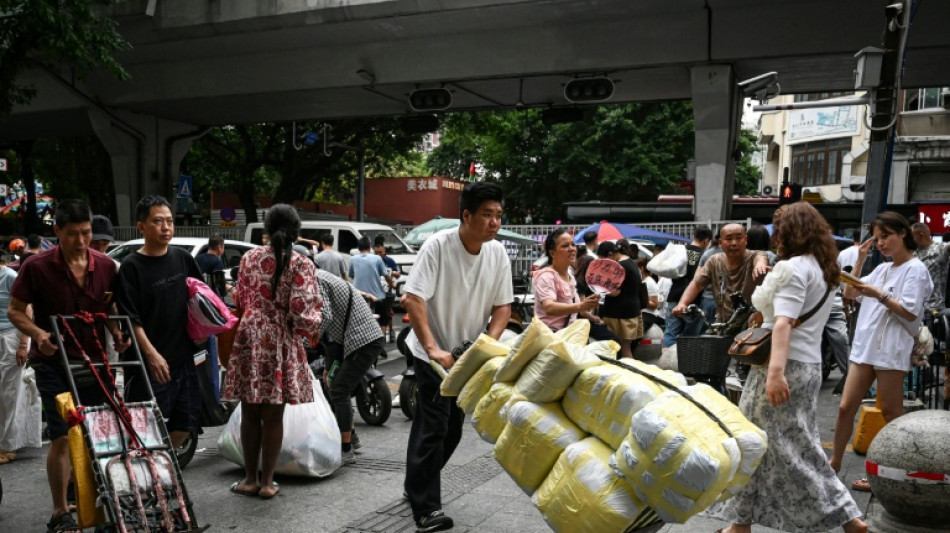
Labourers sweated as they wheeled bags of clothes, shoes and accessories to a sprawling wholesale market in southern China, where shop owners hoped an upcoming visit by Donald Trump would see an easing of tariffs hitting their exports.
Factories in Guangdong province, China's production heartland, have borne the brunt of the president's mercurial policies and a blistering trade war that saw US levies on their goods reach an eyewatering 145 percent for many products.
The tit-for-tat escalation cooled off after Trump and Chinese counterpart Xi Jinping agreed to a one-year truce in October, but manufacturers at the bustling Guangdong market told AFP that US orders had dwindled.
"It's very clear -- American customers have basically vanished," said Zhou Hua, a sales manager at denim company "1988".
Guangdong accounted for around a fifth of China's foreign trade last year, at a record 9.49 trillion yuan ($1.39 trillion), according to China's customs website.
The White House said last month that Trump will visit China on May 14-15, after delaying an earlier summit because of the war against Iran.
China's foreign ministry has not confirmed the dates.
Zhou hopes a Trump visit will mean a reduction in tariffs, which would lead to an increase in orders for his jeans.
While US orders accounted for only around 10 percent of his company's foreign trade, Zhou said the country is a fast fashion hub with "massive demand" for apparel, especially denim.
For now, the company is focusing on exporting the jeans to other countries and also selling them within China.
"We can't put all our eggs in one basket," he added.
- Break the ice -
US tariffs on Chinese goods are a complex web of overlapping rates and product classifications that have evolved in recent years since Trump launched a trade war in his first presidential term.
A February ruling by the US Supreme Court struck down a broad swath of the president's global tolls launched last year.
Using a different legal framework, he swiftly announced a 10 percent global duty with a validity period of 150 days that also applies to Chinese goods.
A Trump summit in China would help to break the ice between Beijing and Washington, 1988's boss Guo Tao said.
"With the two countries fighting this tariff war, it's a lose-lose situation for everyone, it's not a win-win scenario," Guo told AFP.
He is worried not just because of the tariffs but also rising costs of raw materials, exacerbated by the war in the Middle East.
"As business owners, we simply seek a thriving economy, national stability and global peace," he said.
"Only in a peaceful world can we, as merchants, expand our trade to every corner of the globe."
The corridors were packed with Chinese and foreign buyers haggling over prices, while shop owners touted products on live streams in front of glowing phone screens.
A handbag seller surnamed Zhuang told AFP that while her small stall had not been directly hit by Trump's tariffs, she "definitely" felt the ripple effects as price-conscious consumers pulled back on spending.
- 'Strike back' -
"They may want to buy our goods but feel the price is too high and decide against it because these aren't necessities," Zhuang said, perched on a small stool unpacking her goods.
She said she would support Xi's decisions should he wish to be "good friends" with Trump.
"But as for expectations -- well, there really aren't any," she said, adding that Trump was "unreliable".
At another wholesale mall, iridescent streamers and gold mirror balls hung from the ceiling of Wen Linpeng's shop selling colourful soap bars, perfumes and make-up products.
Wen's business does not focus on the US market, but he hoped a Trump visit would bring about more cooperation between the two countries.
China will welcome Trump, Wen said, if the US leader comes with "genuine sincerity".
"If he were to adopt an unfriendly stance -- demanding concessions from China or attempting to coerce us into doing things we are unwilling to do, we would strike back with force," Wen told AFP.
"But if he is willing to cooperate with us, we would be more than happy to work with him."
J.Klein--VZ