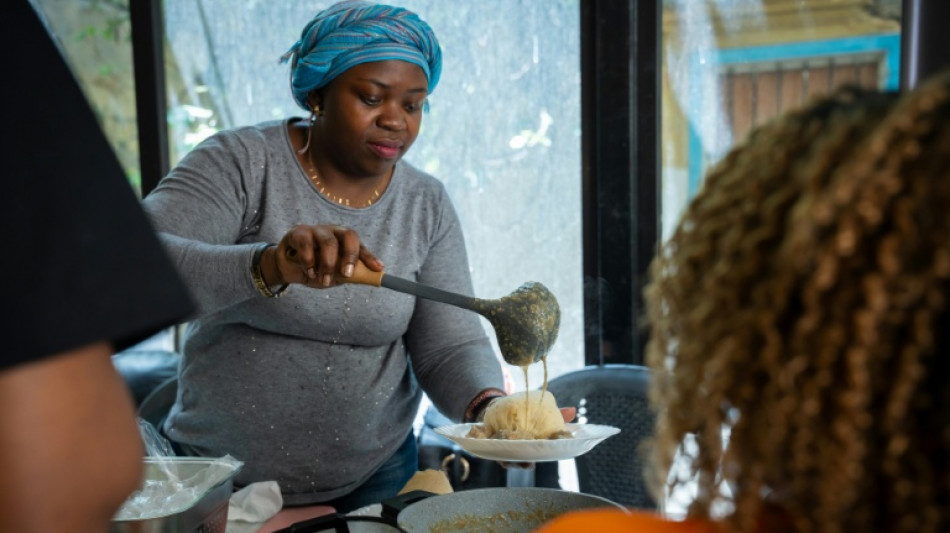
Migrants step up to support community in war-hit Beirut / Photo: Chantale SALAMEH - AFP
At a busy Beirut centre, migrant volunteers stirred pots of okra soup and shaped balls of the African staple fufu, keeping food coming for those caught between the latest Israel-Hezbollah war.
Here, Lebanon's migrant workers, among those hit hardest by the fighting, have stepped up to support others in their community now struggling to get by.
People drifted in and out, collecting bags of food or hot plates, as the air filled with the scent of cooking.
"If we don't do it, no one will do it for us," said Viany De Marceau from Cameroon, who runs REMAN, an NGO supporting African migrant workers.
In recent weeks, De Marceau and her team have shifted their focus to help almost 1,500 volunteers -- mostly migrants from countries like Ethiopia, Benin, Kenya, but also some Lebanese families displaced or struggling to make ends meet.
Lebanon hosts some 164,000 migrants from more than 80 nationalities, most of them women, according to the UN's International Organization for Migration.
At the bustling centre, sewing machines hummed as women stitched blankets, while others stacked thin mattresses ready to be handed out.
"Even in the night we are busy. The phone will not stop ringing," said De Marceau, 33.
Helping others in the community "brings me a kind of happiness", she added.
Across the city in a suburb of Beirut, kitchen shelves were stacked with sauces and tins crowded the walls as volunteers prepared green beans and fried rice balls.
Myra Aragon, 52, from the Philippines, moved between them, helping organise the day's distribution with a smile on her face.
Her Tres Marias organisation, another group supporting migrant workers, has also shifted its focus to the war response.
Aragon said the first calls for help came "as early as 3:00 am" when the war erupted on March 2.
She said she and her volunteers cook around 150 hot meals a day, delivered to people displaced and those in need, helping in whatever way possible despite their limited means.
Outside, migrant women, some with children, left carrying plastic bags filled with basics such as bread and toothpaste.
"We cannot just say to them that, 'sorry, we cannot give you food today because we have nothing to cook'," Aragon said.
"We have to make it happen."
A.Schuster--VZ