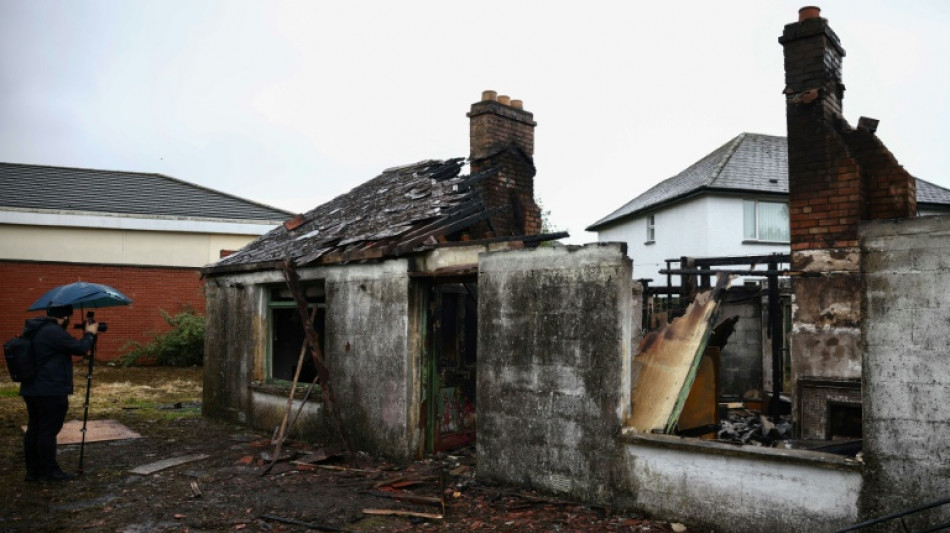
Belfast riots show lingering scars of decades of sectarian unrest / Photo: Henry NICHOLLS - AFP
Days of anti-immigration violence in Belfast have shown how three decades of unrest in Northern Ireland, known as the Troubles, still shape the contours of daily life, residents and academics said.
"We still have a legacy of conflict, of sectarian conflict here," Queen's University Belfast professor Joanne Hughes told AFP.
She was remembering the violence that tore apart largely Catholic, pro-Irish republicans and Protestant, pro-UK unionists for three decades until the Good Friday peace agreement of 1998.
"We still have high levels of community division. We still have segregation, particularly in the most deprived areas," said Hughes, who researches the role of education in divided societies.
After a graphic video of a Belfast man being brutally stabbed, allegedly by a Sudanese man, circulated at the start of this week, riots broke out in primarily unionist, working-class neighbourhoods late Tuesday.
The violence largely unfolded in "interface areas", where Protestants are still divided from Catholic neighbourhoods by fences and signage.
Agitators, many masked young men, torched cars and houses, targeting some minority ethnic homes.
In the aftermath, some locals and pro-Irish politicians pointed fingers at loyalist paramilitaries which still exert influence, especially over boys and young men, in predominantly Protestant areas.
- Loyalist paramilitaries -
There was still "influence here from paramilitary organisations on the union side", said Sean Og O Murchu, a Belfast-based author and republican activist.
"They're sort of the hangover from the Troubles."
The Belfast Telegraph was told by a loyalist source that while they were not "orchestrating or encouraging" the violence, they were deliberately "standing back and refusing to get involved to stop it".
For many, poor access to housing, healthcare and education has been blamed on immigrants, experts said.
Government figures published last month showed that the number of people aged 16 to 24 out of work, not in education or training in Northern Ireland had risen to 11.6 percent, up 1.9 percent from the previous quarter.
"I suspect that most of those who are involved in these riots and violent protests are from communities where they feel disenfranchised, where they feel a lack of hope about the future," said Hughes.
"The perception is that these migrants are taking their houses" but this "isn't true", said Dominic Bryan, a political anthropology professor at Queen's University, creating a new layer of division in the already segregated society.
Northern Ireland is the UK province with the smallest proportion of people from a minority ethnic background -- just over three percent -- per research published last year.
Yet in Belfast, where the Catholic population has surpassed the Protestants since the Troubles ended, unionists "see their identity and their culture shrinking", noted O Murchu.
At the same time, the likes of far-right activist Stephen Yaxley-Lennon, also known as Tommy Robinson, "are saying your culture is shrinking, but it's because of this brown man that lives next door to you".
According to Bryan, recent events "mark a shift in some unionist and Protestant areas, away from the outgroup being Catholics... towards people with a different colour skin".
- 'United Ireland' -
That shift has been proudly claimed by some protesters, with AI-generated images of the Irish tricolour flag and British Union Jack knotted together circulating on social media, and even sported at protests.
"If you know anything about the history of this place, that seems extraordinary," said Bryan.
On Wednesday night, in Glengormley, a northern Belfast suburb which saw clashes between police and rioters, friends John and Brendan expressed their support for uniting against immigration.
"I'm excited that in this moment Catholics and Protestants have realised that actually we're in this together," said John, a 52-year-old Protestant, who asked not to give his last name.
"There's now a united Ireland, but it's united because the ordinary people have realised that, actually, we have been played like puppets."
Brendan, who described himself as a "strong Catholic", said he supported the rioters who had gathered but was against violence. "Nothing was going to unite people more than crimes (or) inhumane acts," he said.
"The Troubles is over, we don't want that back ... hopefully we can put a stop to this" and end the violence on the streets, added the 50-year-old plumber.
But Bryan pointed out that the idea of an anti-immigrant "united Ireland" sentiment was a fringe opinion, and far-right voices on social media had "embraced this idea that the white people in Ireland are somehow rising up".
"I think amongst the population generally, that would be seen as ridiculous," said Bryan.
For O Murchu, people using the "united Ireland" rhetoric to justify the riots was "upsetting". "It wasn't so long ago that it was us, my ancestors, being burnt out of our homes," he said.
E.Franke--VZ