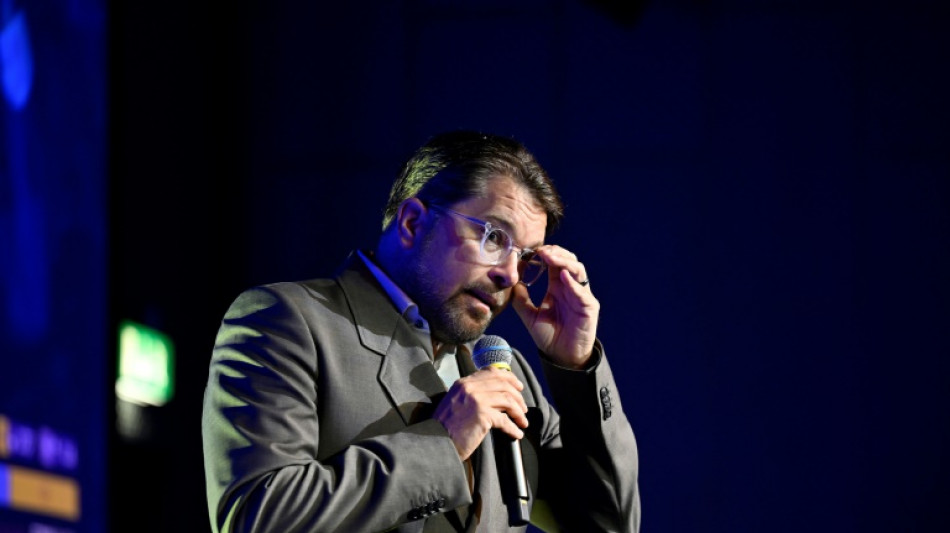
Why the far right is losing ground in Sweden / Photo: Pontus LUNDAHL - TT News Agency/AFP
Unlike other parts of Europe where the far right has been gaining ground, Sweden's weekend election saw the extreme right lose support there for the first time in more than 15 years.
With more than 90 percent of votes counted, the country's left- and right-wing blocs were running neck and neck, with the left holding a razor-thin lead of three seats.
Defying predictions, the Sweden Democrats -- a party with neo-Nazi roots -- suffered an unexpected drop in support for the first time since entering parliament in 2010.
The hardline anti-immigrant party has lost three percentage points compared with the 2022 general election, slipping from 20.5 percent to 17.6 percent.
It has also ceded its position as the Nordic country's second-largest political force.
"We don't yet have the full election result but it's obvious that we've lost a few percentage points compared with our result four years ago," party leader Jimmie Akesson said on election night.
The result bucks a trend elsewhere in Europe, such as in Britain, Germany and Italy, where nationalist, hard-right parties have been on the rise at the polls.
One reason may be that Sweden's mainstream parties have largely adopted a tough stance on asylum seekers, according to political observers at Lund University.
"In the past, many people voted for them (the far right) simply because they liked their stance on refugees", without necessarily believing they were the best party, said Lund political scientist Anders Sannerstedt.
Now, said his colleague Annicka Freden, "many parties are in favour of a restrictive policy and the Sweden Democrats haven't succeeded in being strong on other issues".
- Kristersson and the far right -
Sweden was one of a small handful of western European nations that took in thousands of vulnerable refugees during the 2015 migrant crisis, many fleeing the war in Syria.
But the move was not shared by many other members of the 27-nation European Union and was seized upon by the far right, who built much of their support around opposition to immigration.
But successive governments on both the left and right have since embraced stricter immigration policy, depriving the far right of its hold on the issue.
Sannerstedt and Freden argue the Sweden Democrats had failed to broaden their appeal in other policy areas and were now struggling to remain relevant.
Long viewed as political pariahs, the Sweden Democrats caused a stir in 2022 when they won enough votes to become the country's second-largest party, pushing the right-wing Moderates party of Prime Minister Ulf Kristersson into third place.
Kristersson responded by striking an unprecedented deal with the extreme-right party which enabled his minority right-wing coalition to form a government.
He gave the Sweden Democrats significant influence over government policy -- especially on crime and immigration -- in return for support in parliament.
During this year's campaign, he went further, promising the Sweden Democrats key cabinet posts if he was re-elected.
So another factor behind the far right's losses could have been voters' wish to see the end of Kristersson's administration, said Anders Suhonen, head of the left-leaning think tank Katalys.
- Social issues -
For many voters, it was about "bringing an end to (this) government and blocking the path of the Sweden Democrats", Suhonen said.
Kristersson made immigration a central focus of his four-year term.
But, unlike the election campaign in 2022, the run-up to Sunday's vote was dominated by different issues, like the rising cost of living and the need to protect the welfare state.
Those topics are traditionally championed by the left and centre-left, in particular by Magdalena Andersson's Social Democrats, which governed Sweden for the better part of the 20th century and remains the country's biggest party.
"In Sweden in particular, the Social Democrats have, in a sense, been the party that built society" and this history still resonated with voters, said Suhonen.
Kristersson could still remain in office if the left-wing bloc retains its wafer-thin majority but then fails to form a government due to its members' ideological differences.
But that will only become clear after final results are announced on Wednesday.
E.Franke--VZ