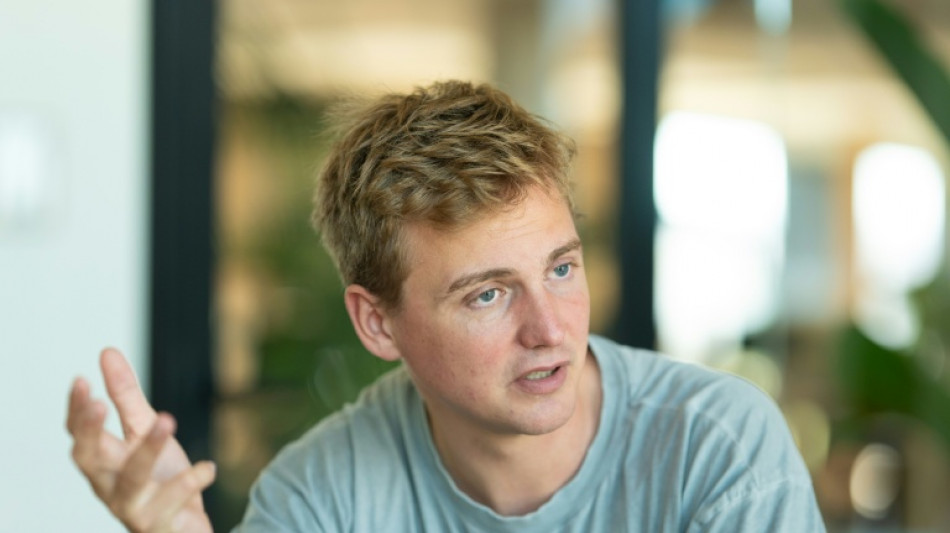
AI startup urges optimism from Europe despite safety fears / Photo: Silas Stein - AFP
Europe needs to view artificial intelligence with more optimism -- despite growing warnings about its dangers -- or risk falling further behind, the head of a leading European AI start-up warned.
"I think the mindset in Europe needs to shift to one of optimism and to one of opportunity, and not to one of risk and fear," Robin Rombach, CEO of German AI image generation specialist Black Forest Labs, told AFP.
Europe lags behind the United States and China when it comes to cutting-edge AI models. Policymakers and firms have been scrambling to find ways to make up lost ground.
But the debate has shifted to safety in recent weeks, after security lapses sparked calls from some industry leaders for development of the technology to be slowed down.
Based in the medieval German city of Freiburg, Rombach's company -- which takes its name from the nearby Black Forest -- has emerged as a prominent developer of AI image-generation models.
The startup, valued at around $3.25 billion, recently hit the headlines when it announced US director Martin Scorsese as an advisor, prompting an angry response from some in Hollywood concerned about AI taking production jobs.
Rombach, 33, helped develop latent diffusion, a breakthrough that underpins many of today's AI image-generation systems.
This propelled Rombach and a group of fellow computer scientists to found the AI lab in 2024. With just over 100 staff, its FLUX models generate still and moving images from text, and the company is now also expanding into physical AI.
Its latest model has been tested at carmaker Audi as part of a project aimed at enabling robots to perform production-line tasks.
Despite its roots in Freiburg -- Rombach comes from the area -- the firm's ties to the United States and its tech scene are also strong.
The company has a second headquarters in San Francisco and secured early backing from Silicon Valley venture capital firm Andreessen Horowitz.
- 'Stupidity' is biggest risk -
Rombach said that when Black Forest Labs was founded, there was no "real startup ecosystem" in Europe, particularly for "frontier deep tech".
"If you want to build a frontier model in a very competitive space, you need to do this quickly."
"Certain ingredients" are needed for success, such as a lot of capital and computing power, he added.
As well as Black Forest Labs, Europe has other competitive AI companies, including France's Mistral, but is still seen as trailing US firms such as OpenAI and Anthropic and Chinese labs such as DeepSeek.
Zach Meyers of CERRE, a Brussels-based think tank, echoed some of Rombach's concerns, saying the "biggest barrier" to AI growth and innovation in Europe was access to capital.
Most European companies rely on financing from banks, which are traditionally more cautious than venture capital investors about backing businesses that may take years to become profitable, said Meyers, an expert in EU digital policy.
"That is not how technology markets work, particularly with a really nascent technology like AI," he told AFP.
Safety concerns related to AI have escalated after incidents of the technology getting around controls during tests, sparking dire warnings from some about the threats that it poses.
Rombach emphasised his company's focus on "open-weight" AI models, some of which can be downloaded by researchers and developers, "increases transparency, increases safety".
He called for an open approach to AI development, warning it would be "fundamentally wrong" for such a crucial technology to be controlled by a few companies, rendering oversight more difficult.
But for Rombach, the biggest danger rests in potential human failings.
"The main thing that can wipe out humanity is stupidity," he said.
H.Weber--VZ